
Blog Detail
- Oct 15, 2026
A prostate operation is a major decision, particularly when cancer, urinary symptoms and time away from home are already weighing heavily on you. When comparing robotic versus open prostate surgery, the key question is not simply which approach is newer. It is which operation is clinically appropriate for your condition, anatomy, previous treatment and personal priorities.
For New Zealanders facing long waits or substantial private costs, overseas treatment can add another layer of choice. A clear discussion with an experienced urologist should come first. The surgical method matters, but so do the surgeon’s experience, hospital standards, expected recovery and the practical support available once you leave hospital.
First, confirm which prostate operation you need
The phrase “prostate surgery” can describe different procedures. For localised prostate cancer, the most common operation is a radical prostatectomy, where the prostate gland and seminal vesicles are removed. The aim is to remove the cancer while preserving urinary control and sexual function where safely possible.
For a very enlarged prostate causing urinary blockage, a simple prostatectomy may be considered. This removes the obstructing part of the prostate but does not treat prostate cancer. Robotic and open techniques can be used for both procedures, although the comparison is most often discussed in relation to radical prostatectomy.
Before choosing an approach, your specialist will consider your PSA level, biopsy results, MRI findings, cancer stage, prostate size, urinary symptoms, general health and previous abdominal or pelvic surgery. Some men may be better served by radiotherapy, active surveillance or another treatment rather than surgery at all.
Robotic versus open prostate surgery: how they differ
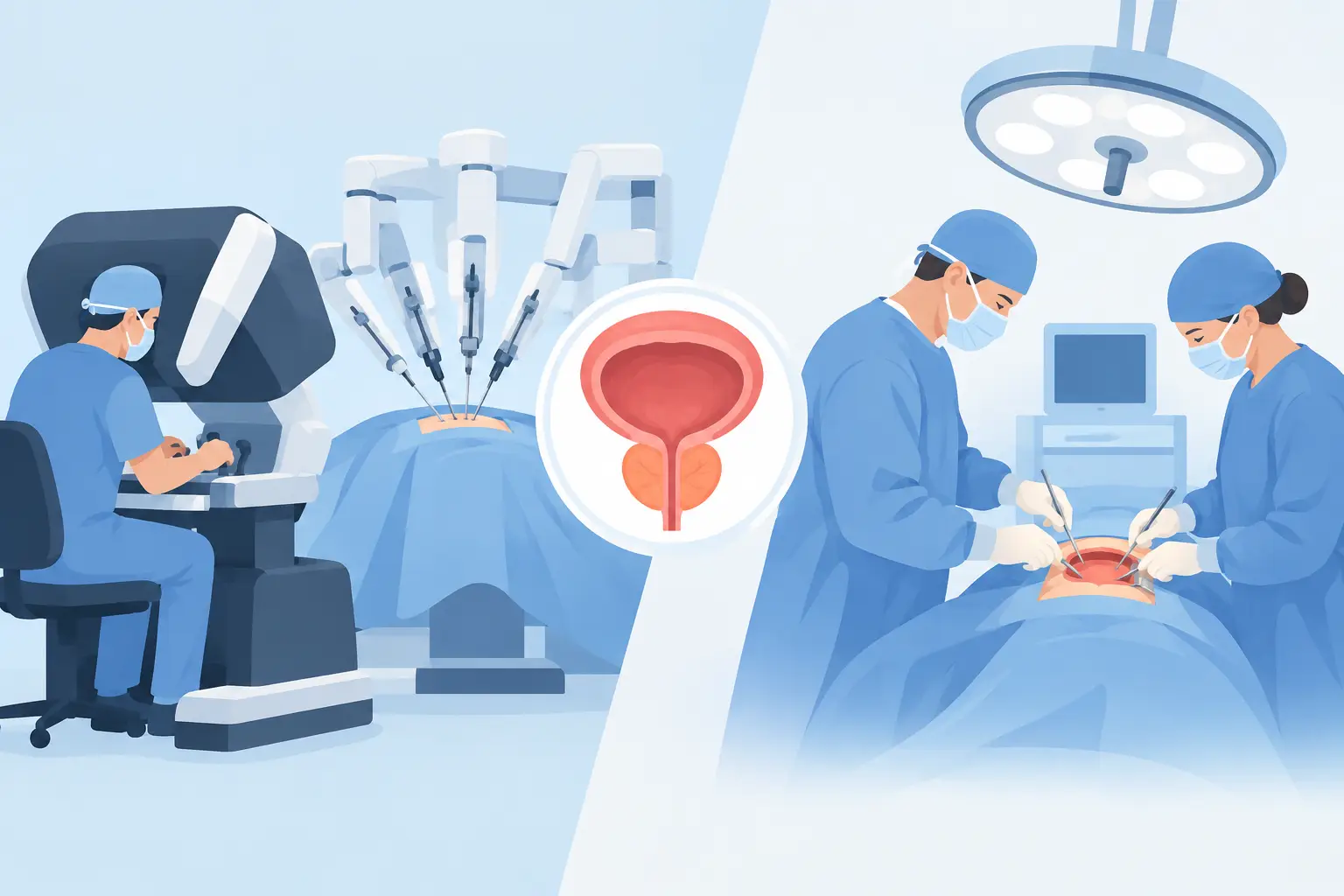
Open prostate surgery is performed through one incision in the lower abdomen. It is a long-established technique, and in the hands of a high-volume specialist it can produce excellent cancer-control results. The surgeon operates directly through the incision, using conventional surgical instruments.
Robotic surgery is a type of minimally invasive, or keyhole, surgery. The surgeon makes several small incisions and controls robotic instruments from a console. The system provides a highly magnified three-dimensional view and allows precise movements in the confined space around the prostate, bladder, nerves and urethra.
The robot does not operate independently. The surgeon remains fully in control throughout the procedure. This distinction matters because the experience and judgement of the urologic surgeon are more significant than the name of the technology alone.
For many suitable patients, robotic radical prostatectomy is associated with less blood loss, smaller wounds, less post-operative pain and a shorter hospital stay. Recovery can also be quicker, although “quicker” does not mean immediate. Pelvic surgery still requires weeks of gradual healing, activity restrictions and follow-up.
Open surgery may involve more blood loss and a longer initial recovery, on average, but it remains a sound option. It can be particularly appropriate where robotic access is unavailable, where a surgeon believes an open approach offers better control in a complex case, or where an individual’s surgical history makes keyhole surgery less suitable.
Cancer control and quality-of-life outcomes
For localised prostate cancer, both robotic and open radical prostatectomy can achieve strong long-term cancer outcomes when performed by skilled teams on appropriately selected patients. Current evidence does not support choosing a surgical method on the assumption that the robot will automatically remove cancer more effectively.
The more personal issues are urinary continence and erectile function. These can be affected by either approach because the prostate sits close to the urinary sphincter and the nerves involved in erections. Robotic visualisation and instrument control may help surgeons perform delicate nerve-sparing techniques in suitable cases, but outcomes vary considerably.
Age, pre-existing erectile function, diabetes, smoking, prostate size, tumour position, whether nerve-sparing is safe, and the surgeon’s experience all influence recovery. Some men regain urinary control in a matter of months; for others, it takes longer. Erectile recovery can take many months to two years, and some men need medication, vacuum devices, injections or other support.
No reputable surgeon should promise full continence or preserved sexual function. Ask for realistic outcomes based on patients similar to you, rather than broad marketing claims. It is also reasonable to ask how many prostatectomies the surgeon performs each year and how their team measures functional results after surgery.
Recovery is more than the number of incisions
After either procedure, patients usually have a urinary catheter for around one to two weeks, depending on the operation and healing. Once it is removed, leakage is common at first. Pelvic floor physiotherapy before and after surgery can be an important part of regaining control.
Robotic patients may leave hospital sooner, sometimes within one to three days, while open surgery can require a longer admission. However, safe recovery also depends on pain control, mobility, bowel function, wound healing and access to prompt clinical advice if concerns arise.
Travelling too soon after major pelvic surgery is not sensible. Long-haul flights increase the risk of blood clots and can be uncomfortable while a catheter is in place or while mobility is reduced. Your treating team should set a personalised fitness-to-fly timeframe, and this should be built into any overseas treatment plan from the outset.
When an overseas robotic procedure may be worth considering
Patients considering treatment abroad often want faster access to an experienced surgeon and advanced technology, with transparent costs before committing. In India, Thailand, Malaysia, Indonesia and Turkey, some internationally accredited hospitals offer robotic urology programmes with dedicated prostate cancer teams.
Cost can be an important factor, but it should never be the only factor. A meaningful comparison includes the surgeon’s credentials and caseload, hospital accreditation, theatre and intensive-care capability, pathology services, length of stay, complications cover, medication, physiotherapy, follow-up arrangements and the likely time required before flying home.
You should also clarify exactly what is included if the operation becomes more complex than expected. For example, ask whether additional imaging, blood products, high-dependency care, an extended admission or management of a complication may create extra charges. Transparent answers before travel are a sign of a well-organised treatment pathway.
Wellaway Meditours can help New Zealand patients coordinate accredited hospital options, compare treatment inclusions and arrange the practical elements around surgery, including travel, accommodation and support for a companion. That coordination is particularly valuable for a procedure where timing, recovery and post-operative review need careful planning rather than a rushed itinerary.
Questions to take to your urologist
Ask whether surgery is the best treatment for your specific cancer or urinary condition, and whether nerve-sparing surgery is oncologically safe. Ask why robotic or open surgery is recommended in your case, how often the surgeon performs the procedure, and what recovery milestones they expect.
It is also wise to discuss the risk of needing a blood transfusion, the expected catheter duration, continence rehabilitation, sexual-function support and the plan if pathology shows a higher-risk cancer than anticipated. If travelling, ask when you can safely fly, how follow-up will work after you return to New Zealand, and who to contact if you develop a problem at home.
The best choice is the one that combines sound clinical reasoning with a surgeon and hospital you trust, a realistic recovery plan and support that continues beyond the operating theatre. Taking the time to compare those details can turn a difficult decision into a clearer path forward.